"If you have not yet encountered this extraordinary man of music, you will probably be as fascinated as the children and will marvel at his multiple gifts as a composer, conductor and solo instrumentalist." - The New York Times | "A major premiere, 'THIS LAND Symphonic Variations on a Song by Woody Guthrie' by David Amram is no whimsical notion quickly tossed off, but rather a major, serious work ..." - The San Francisco Classical Voice|"David Amram has wandered through the past 60 years of American music, giving himself permission to pass through genre neighborhoods like almost nobody else.” - New York Times, by Ben Ratliff | “Renaissance Man of American Music”-Boston Globe“David Amram is one of the most versatile and skilled musicians America has ever produced.” - Washington Post | "A One-Man Folk Festival, who was multi-cultural before multi-culturalism existed!" - New York Times" | He is a composer of major stature, a conductor of winning authority and a jazz musician of noble intent and entertaining brilliance." - The Newhouse Newspapers | "Amram dazzled with his versatility...One could be but awed by his range...Amram was constantly enlightening." - The London Times | "David Amram...a musical catalyst and leader on a par with Leonard Bernstein, Pete Seeger and Dizzy Gillespie" - Minneapolis Star Tribune | "Amram's American music is joyous, great, beautiful…" - The Kansas City Times | "Galway inspired in 'Giants of the Night'...Throughout Amram's genius was apparent…An exceptional composition with great potential for becoming part of the flute repertoire." - The Times Picayune (New Orleans) | “David Amram is the quintessential American composer.” - Michael Barrett, Conductor, Director of Caramoor and Moab Music Festivals
ABOUT DAVID AMRAM
“A Godsend to those who believe in the power of music to change lives and inspire” - Wynton Marsalis | “He’s one of the most talented musicians in the universe!” - Pete Seeger, New York Times | “This guy’s an All-American eclectic!” - Nick Spitzer of NPR’s American Routes | “Every profession should have its Amram!” - George Plimpton, author |“Amram remains the most indefatigable musician of our time.” - Douglas Brinkley, historian
David Amram has conducted more than seventy-five of the world’s great orchestras, composed more than 100 orchestral and chamber works, written two operas and, early in his career, composed and conducted many scores for theater and films, including Splendor in the Grass and The Manchurian Candidate. Since being appointed by Leonard Bernstein as the first composer in residence with the New York Philharmonic in 1966, he has become one of the most acclaimed composers of his generation, listed by BMI as one of the 20 Most Performed Composers of Concert Music in the United States since 1974.
For twenty-nine seasons, Amram was the Music Director, Conductor and Narrator of Young People's, Family and Free Summer Parks concerts for the Brooklyn Philharmonic at the Brooklyn Academy of Music; and for seventeen seasons, Amram was the Musical Director and Conductor of the International Jewish Arts Festival, conducting members of the Metropolitan Opera Orchestra. In addition to conducting, he has also performed with symphony orchestras as a
soloist on instruments from all over the world, combining jazz, Latin American, Middle Eastern, Native American and folk music alongside the European classics.
Along with Julius Watkins, Amram is an acknowledged pioneer player of jazz French horn since the 1950s, as well as being known as a trailblazer for World Music. He is also a virtuoso on piano, numerous flutes and whistles, percussion, and dozens of folkloric instruments from 25 countries, as well as an inventive, funny improvisational lyricist. He has collaborated with Leonard Bernstein, Sir James Galway, Dizzy Gillespie,
Langston Hughes, Jack Kerouac, Dustin Hoffman, Willie Nelson, Thelonious Monk, Odetta, Pete Seeger, Elia Kazan, Arthur Miller, Charles Mingus, Floyd Red Crow Westerman, Lionel Hampton, Johnny Depp, Betty Carter, Tito Puente and Kenneth Radnofsky.
A documentary feature film, David Amram: The First 80 Years, is currently being shown at major music and film festivals throughout the United States and internationally. Directed by Lawrence Kraman, the film includes the New York premier of his Symphonic Variations on a Song by Woody Guthrie and highlights of his comic opera 12th Night and The Final Ingredient, an opera of the
Holocaust.
The Lincoln Center of the Performing Arts Library, has acquired Amram's complete archive and his recent honors include the second annual Pete and Toshi Seeger Power of Song Award and the Jay McShann Lifetime Achievement Award when recently inducted into the Oklahoma Jazz Hall of Fame.
Today, Amram continues to perform as a guest conductor, soloist and narrator in five languages, while continuing a remarkable pace of composing. Recently acclaimed new works include Three Songs: A Concerto for Piano and Orchestra; and Giants of the Night, a flute concerto commissioned and premiered by Sir James Galway. A Little Rebellion: Thomas Jefferson, a piece for narrator and orchestra, was premiered at
the Kennedy Center with Amram conducting; and Kokopeli, A Symphony in Three Movements, had its world premiere with the Nashville Symphony Orchestra, also with Amram conducting.
David Amram Contact
Nora Guthrie Contact
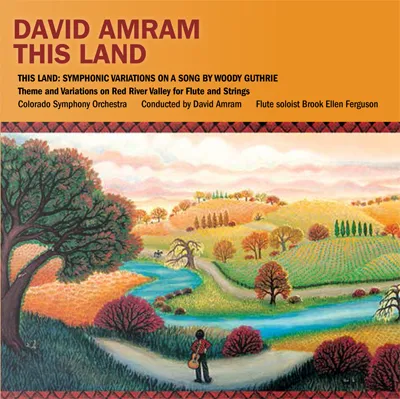
THIS LAND - Liner Notes
by David Amram
As I sit here in the delicious silence of upstate New York, in the Spring of 2014, I am listening to the recording by the Colorado Symphony Orchestra's performance of THIS LAND: Symphonic Variations on a Song by Woody Guthrie. As I hear the final set of variations of THIS LAND, all inspired by Woody's occasional wanderings through the streets to New York City's urban mosaic of neighborhoods, I flash back fifty eight years ago, to a cloudy afternoon in 1956
on the Lower East Side of New York City. That was when and where I first met Woody Guthrie. Ahmed Bashir, a friend of Charlie Parker, Sonny Rollins, and Charles Mingus (with whom I was playing at that time), took me over to meet Woody at his friend's apartment a few blocks from mine.
Ever since that day we first met, more than a half a century ago, I always hoped that someday I would get the chance to go to his hometown of Okemah, but with my crazy schedule I never had the opportunity to do so. In 2005, shortly after Nora Guthrie asked me to compose a full-scale symphonic composition to honor Woody's classic song, This Land is your Land, I was invited to perform at WoodyFest, the annual summer festival in Okemah. I was now able to
make a connection, since that first meeting with Woody over a half a century ago, to the ensuing years during which I played countless times with his old friend Pete Seeger and his protégé Ramblin' Jack Elliott. Spending time in Okemah and Tulsa made me appreciate even more the times I spent with Woody's late wife, Marjorie in New York, and the numerous concerts I have participated in with his son Arlo and other members of the Guthrie family over the years.
All these experiences helped me when composing THIS LAND: Symphonic Variations on a Song by Woody Guthrie. The opening Theme and Fanfare for the Road has the percussion introduce the actual notes of Woody's song This Land is your Land, played by the marimba, followed by a fanfare, expressing Woody's desire to go out on that open road.
THIS LAND: SYMPHONIC VARIATIONS ON A SONG BY WOODY GUTHRIE, was commissioned by the Guthrie Family and Woody Guthrie Publications. It premiered September 29th, 2007 by the Symphony Silicon Valley in San Jose California, conducted by the brilliant young American conductor Paul Polivnick. The piece has been performed numerous times since its premier. In September of 2012, it was recorded in Denver in this live
performance by the Colorado Symphony Orchestra as the featured piece in a concert honoring Woody Guthrie's 100th birthday.
THEME AND VARIATIONS ON RED RIVER VALLEY FOR FLUTE AND STRINGS In 1990, Rod Kennedy, the founder of the Kerrville Texas Music Festival, commissioned me to compose a piece for Texas flute virtuoso Megan Meisenbach and conduct a group of string players from the neighboring San Antonio and Austin Symphony Orchestras, to be premiered out of doors June 6, 1991 at the Quiet Valley Ranch, to celebrate their 20th anniversary. The Festival wanted
the theme to reflect the beauty of indigenous folk lore of the American West in the same way that Tchaikovsky, Brahms, Borodin, Dvorak, Bartok, Ellington, Ives and Gershwin celebrated their respective cultures.
In 1976, fourteen years prior to composing Theme and Variations on Red River Valley for flute and strings, I performed at the Kerrville festival. On the final day of the festival, singer-songwriters Bobby Bridger and Gary P. Nunn took me to spend a memorable afternoon in Lukenbach, Texas (population 7) with Hondo Crouch, Lukenbachs' indefatigable founder, owner, mayor, retired rancher, teacher, actor and a full time host, story teller and "Imagineer"
(The title of his job description on the calling card he gave me).
As the day, afternoon and night of merry making took place, Hondo held court, entertaining the throng of old friends, farmers, ranchers, musicians, artists, tourists and anyone who showed up, as he sang and improvised for hours, including a stunning half hour version of "Red River Valley".
Fourteen years later, in 1990, when I was asked by the Festival to compose a piece for flute and strings based on a Western theme, I knew which song to use. The renowned flutist Julius Baker recorded it for Newport Classic Recordings released in 1993 and it was performed at the Kennedy Center Oct 22, 1995 in
a concert which I conducted with the National Symphony, celebrating the 50th anniversary of the chamber orchestra version of Aaron Copland's Appalachian Spring, a favorite piece of the Guthrie family.
From the composition's stately beginning through the various statements of the theme and the ensuing variations, I tried to paint an orchestral picture of the remaining beauties of the western United States.
For artists like Jack Kerouac and myself, Colorado, Oklahoma and Texas were magical places we could only dream of seeing some day when we were growing up in the 1930s during the Great Depression and watching old Western movies. We were both lucky to go out West later on in our lives. This CD honors the enduring legacy of both Woody Guthrie and Hondo Crouch, two of the magicians who shared some of that magic of this part of the country with the world, and
whose work still inspire so many people today.
-David Amram, Putnam Valley NY, April 26, 2014
DAVID AMRAM AND WOODY...SUITE!
By Nora Guthrie, Fall 2005
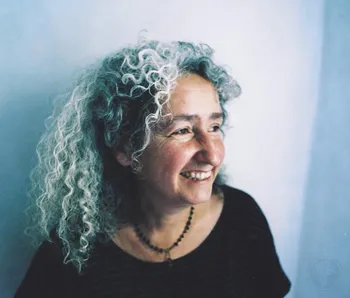 Photo by Tina Tschirch
For a while now I’ve been thinking that it would be both interesting and challenging to have Woody’s music made more accessible to classical music groups – either large orchestras or smaller ensembles. Although there have been some arrangements and recordings of This Land Is Your Land over the years - the Boston Pops Orchestra for one - there hasn’t been an arrangement, or composition, that I feel presents Woody’s idea behind
the song, albeit in the classical tongue!
This got me to thinking. And after thinking, the creative juices just started flowing.
My train of thought, as always, took some unexpected turns bringing up more than I anticipated; from personal memories, to musical compositions and performances I’ve heard over the years. Sparks of ideas began to fly. Working backwards on some inner trail, I was taken back to 1955.
My mother, Marjorie Guthrie, was a member of the Martha Graham Dance Company from 1935 to the early 1950’s. She was in the original cast of the ballet Appalachian Spring when Aaron Copland was commissioned to compose the score for Graham. Brilliantly incorporating the Shaker hymn “Simple Gifts” into his score, Appalachian Spring has since become a classic – both the ballet and the musical composition.
As children, we were taken annually to see all the Graham Company performances. I remember the first time we saw Appalachian Spring. Although we were very young, the experience was profound. I remember holding back my tears at the conclusion of the ballet as I watched the young, married couple settle on to their porch. With their life together just beginning, their postures held a steadied excitement as they prepared themselves for the work that lay ahead,
and the challenges. I could feel all their innocent dreams and hopes and their inner strength. For me, Copland’s use of “Simple Gifts” conveyed the simple idea that having such a beginning was the gift itself.
Appalachian Spring was played regularly in our home. My mother played the record on Sundays as she worked around the house. I felt her pride when we heard it on the classical radio station as we drove in the car. It was a very intimate experience for her, reminding her of her own beginnings as a young adult starting out as a dancer, meeting my father in New York during this period, and sitting on their own porch – a little tenement stoop in front of
their apartment in Coney Island – as they began their own combined life and destiny. Somehow we children understood the tremendous meaning of this beautiful work and we would become still and silent, listening to the melody which resonated something of our own existence to us.
I suppose I could say that to this day "Appalachian Spring" is our family song, representing our own beginnings, our family history, and the tone of our family life together as dreamed of by our parents. You could say it is our family anthem.
Over the years, many people have considered "This Land Is Your Land" to be America’s alternative national anthem. Although most of us learned the song in schools, around campfires, at hootenannies and in folk circles, arrangements of the song have also been played by hundreds of marching bands around the country – from high school marching bands to the our military marching bands. This style of arrangement has become a staple at
everything from Presidential inaugurations, national holidays to other public events and ceremonies. It is most often the chorus, rather than the verses, which are celebrated. My father certainly would have laughed at the irony. Go figure!
Recently, I've been struck by the similarities between "Appalachian Spring" and "This Land". Appalachian Spring is, in my opinion, a quintessentially American composition expressing much about the beginnings of our young, national soul with much ahead to learn and so much energy to work with. This Land holds a similar place in our national repertory, and I’ve often felt that it could be understood and heard as Woody’s
continuation of the story. One could almost feel "This Land" as the child of "Appalachian Spring".
In Woody's song, this same Appalachian Spring soul now appears slightly more grown up. Adolescent in tone, it is now heard as a young “citizen” –a new watcher, a thinker, a doer, an activist. Although still wondrous by nature, Woody notes that along with budding maturity comes the budding of critical thinking. Woody’s soul, which he names “you and me”, is revealed anew as a ripening participant – one who continues
to feel wonder but can begin to frame the question “why?” It is also in a state of wonder that he begins to ask “what can I do?”
Woody calls this combination of attributes a Worker. But not only workers of jobs. Woody says we are also workers and growers of a country. Woody suggests that “you and me” are one continuous flow of workers of citizenry. He tells us that our most important job is to grow up and work up our best Ideas. This will naturally reflect in our individual, specific “job of work”.
"This Land Is Your Land" is often trivialized, and it’s true meaning – as I understand it – simplified to a modest common denominator; an “America” defined by a temporary group of a few. This is always bound to happen. No matter who is in office, who is in charge, and which side they’re on, the translation of the song will inevitably be modified to serve someone’s agenda. And it often proves to be
everyone’s agenda except Woody’s!
With all this in mind, I approached acclaimed composer David Amram to ask if he would be interested in composing a new score based on "This Land". In addition to having known Woody personally, David has been at the center of much of our cultural history, working and collaborating with the most diverse group of artists – from Dylan, to Kerouac, to Arthur Miller and on and on. Having composed a multitude of orchestral suites and film scores,
including the original score for The Manchurian Candidate, it’s been firmly acknowledged that David is a musical genius in his own right.
Rather than creating an arrangement, I asked him to create a composition that would express some of the song’s truer meanings - to use the text and melody as an inspiration, a foundation, from which he could expand on. Just as Aaron Copland honored “Simple Gifts” as his muse, so might David create an honest and honorable tribute to the many seed-thoughts which Woody planted within the lyrics of "This Land".
David and I have spent many hours talking about the lyrics, their meaning, and about Woody. We’ve talked about his life, his experiences, and talked about how they might have shaped him, and how they appear in all the six verses of the song. We’ve talked about society, culture, and politics. This summer, David traveled to Okemah, Oklahoma where he performed at the Woody Guthrie Free Folk Festival and where he talked with Woody’s family,
friends, musicians and fans.
We've had a lot of fun sharing our thoughts and feelings on all these topics. Of course, any conversation about This Land could (and will) go on and on. And I’m sure many of you reading this have additional points, comments and pieces of the puzzle to offer. That’s what makes "This Land" such an interesting piece to work with. I don’t think we’ll ever be able to nail it down, just as we can never nail down Woody. His
vision might just be too broad and test our understanding. (With a wink, he might ask us to hear something in the marching band arrangements as an expression of something that could be equally used for some good).
David Amram is now busy at work creating what he titles “Symphonic Variations on a Song by Woody Guthrie”. We are hoping that it will have a premier sometime in 2006, and have begun looking for the right conductor, the right orchestra, the right town and the right time.
I truly look forward to the night when I will be able to sit in the orchestra hall and hear David’s work for the very first time. It will be as thrilling for me as the very first time I went to see Graham’s ballet Appalachian Spring. But this time, like the young couple, we will be the ones who will settle into our seats, our postures steadied with excitement as the conductor lifts his baton!
On that night, I hope the conductor, the musicians, and the audience will experience the same pride my mother always felt when she heard Appalachian Spring – knowing that she was present when this new work was created and unveiled. I hope they will become still and silent, and listen to this melody – being one that is both so old and so new - and that it will resonate something of our own existence to us as citizens in this still young country.
I hope it will touch us, mentor us, teach us, and guide us.
I hope that future audiences will enjoy this new exploration of This Land and feel in it another new beginning. I hope it will sound of the work ahead of us and praise the many, many citizens that will do it. I hope it will pulse with the rhythms of our challenges and that we’ll feel like dancing through them! I hope we will feel our own much needed strength in it. I hope it will touch our national soul.
And to David Amram, sitting on his own front porch – the composer’s seat – I hope it will be a moment where he feels us all around him, as audience and as community, as we send him off with a smile and a hug. We wish him well as he takes on his own job of work - introducing “Symphonic Variations on a Song by Woody Guthrie” to the world.
-Nora Guthrie